Will AI replace product designers? A working answer
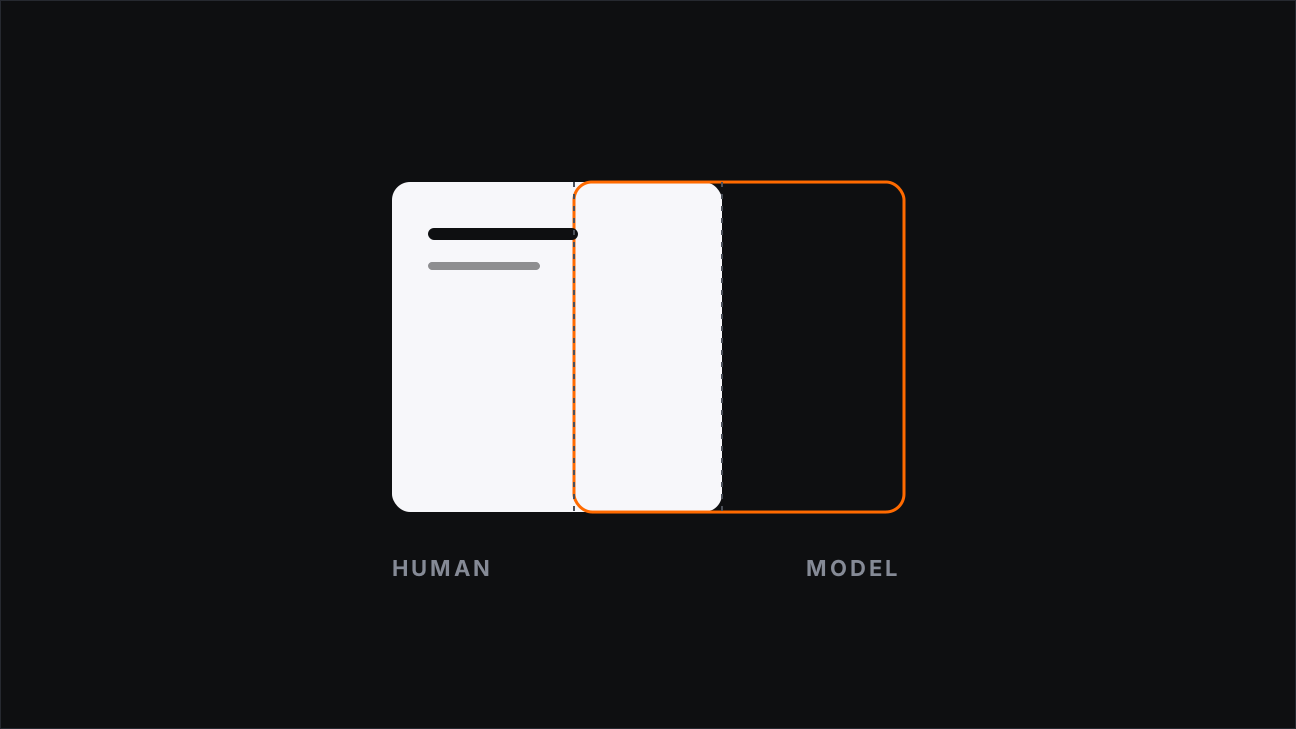
AI has compressed the distance between an idea and something a person can actually click. That is a real change in how product design gets done. What it has not changed is the harder half of the job: deciding what deserves to exist, and being answerable for that decision.
Will AI replace product designers?
No — but it will replace a description of the job that a lot of designers were quietly relying on.
If your value was producing artefacts — screens, specs, redlines, the fourth variation of a flow for a different stakeholder — that value is falling fast, because artefacts are exactly what these systems are good at. If your value was deciding what the product should do and why, and defending that in a room, nothing has happened to it. The uncomfortable part is that many roles were a mix, and the mix has shifted underneath people without anyone announcing it.
What did AI actually make faster?
Three things, all of them production rather than thinking.
- Synthesis. Interview notes, support tickets and analytics turn into a first-pass structure quickly — one I still argue with, but no longer assemble by hand.
- Exploration. Instead of polishing one direction and defending it, I can put three genuinely different structures in front of a team and let the comparison do the convincing.
- Working prototypes. The gap between a static screen and a clickable product has narrowed enough that testable behaviour arrives before development starts rather than after.
None of that is a small change. Being able to test a direction instead of arguing for it is the difference between design as advocacy and design as evidence.
What did not get faster?
Judgment, and it got more exposed rather than less.
When you can produce five versions of a screen in an afternoon, the bottleneck moves to knowing which one is right — and that answer comes from context a model does not have. The customer who churned last quarter. The legacy constraint nobody wrote down. The commercial reason a feature exists at all. The thing somebody said once in a meeting that changed what the product was for.
A model can give you a hundred options. It cannot tell you which one you will still be willing to defend in six months.
Who is accountable for what ships?
The same person as before, and this is the part teams get wrong first.
Carrying more of the pipeline yourself — strategy, structure, interface, motion, a working front end — means owning more of the failure too. If the prototype ships behaviour that confuses people, "the model wrote it" is not an explanation anyone accepts, and it should not be. Speed does not distribute responsibility; it concentrates it, because there are fewer people between the decision and the user.
How should a team actually work with it?
Treat it as a fast, tireless, occasionally overconfident collaborator who has never met your users.
- Give it the volume — the boring, repetitive, high-quantity work that was never craft.
- Review everything it returns as if a junior designer had made it, because that is roughly the level of context it is working from.
- Keep the decisions, the trade-offs and the accountability on the human side of the table.
- Watch for confident wrongness. Generated work is most persuasive exactly where it is weakest — a flow with real domain rules comes back plausible and wrong, which is more dangerous than obviously broken.
What does this mean for designers starting out?
It means the ladder changed shape, and pretending otherwise does nobody a favour. The production work that used to be how juniors earned their reps is the work that got cheapest. The compensating advantage is that a junior designer can now carry an idea much further alone — far enough to have an opinion worth defending, which used to take years of access.
The skill to build deliberately is the one in the test above: being able to tell when the output is wrong. That comes from doing the work, not from watching a model do it.
The short version
AI carries the volume. I carry the direction. It drafts; I decide. It produces variations; I set the criteria those variations are judged against. The moment that inverts — the moment the output starts setting the direction — the work drifts toward whatever is statistically ordinary.
Used that way, it does not flatten the craft. It removes the part of the job that was never craft in the first place.